Quick start demo (Visium ONT)#
This notebook showcases the SPLISOSM spatial isoform analysis workflow on a SiT (Visium-ONT) mouse olfactory bulb (MOB) dataset, which includes the following steps:
Run spatial variability (SV) tests to find genes with variable expression (SVE) or isoform usage (SVP).
Run differential isoform usage (DU) tests against spatial regions to find region markers.
Run differential isoform usage (DU) tests against RNA binding proteins (RBPs) to find potential regulators.
The preprocessed MOB dataset is available for download from Dropbox (~100 MB). For preprocessing details, see related scripts from the SPLISOSM paper.
mob_ont_filtered_1107.h5ad: AnnData object of isoform counts with spot metadata.mob_visium_rbp_1107.h5ad: AnnData object of RBP gene counts with spot metadata.
Estimated runtime: ~10 min.
Imports#
from pathlib import Path

import warnings
from sklearn.exceptions import ConvergenceWarning
from scipy.stats import spearmanr
import numpy as np
import pandas as pd
import scanpy as sc
import matplotlib.pyplot as plt

from splisosm import SplisosmNP, SplisosmGLMM
from splisosm.utils import run_hsic_gc, add_ratio_layer
# Update this path to your local data folder
DATA_DIR = Path("path/to/data/")
ont_path = DATA_DIR / "mob_ont_filtered_1107.h5ad"
rbp_path = DATA_DIR / "mob_visium_rbp_1107.h5ad"
Load isoform-level AnnData#
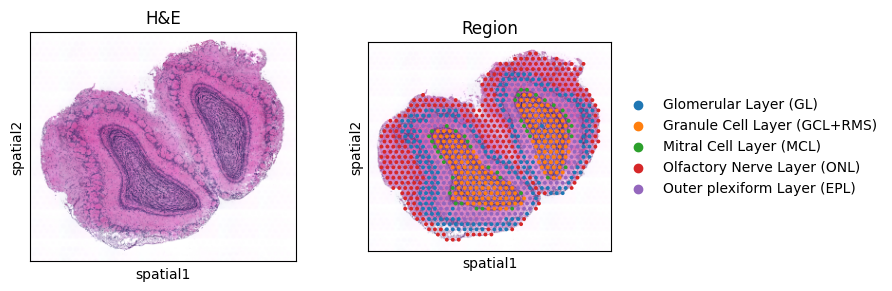
This MOB dataset contains only 918 spots and 1871 genes. Raw UMI counts, log-normalized counts, and isoform usage ratios are precomputed and stored as separate layers.
adata_ont = sc.read(ont_path)

# # log normalize
# sc.pp.normalize_total(adata_ont, target_sum=1e4)
# sc.pp.log1p(adata_ont)
# adata_ont.layers['log1p'] = adata_ont.X.copy()

# # compute observed isoform ratios
# from splisosm.utils import extract_counts_n_ratios
# _, _, _, ratio_obs = extract_counts_n_ratios(
#     adata_ont, layer = 'counts', group_iso_by = 'gene_symbol'
# )
# adata_ont.layers['ratios_obs'] = ratio_obs.copy() # dense matrix of shape (n_spots, n_isos)

print(f"== Number of spots: {adata_ont.n_obs}")
print(f"== Number of genes: {adata_ont.var['gene_symbol'].nunique()}")
print(f"== Number of isoforms: {adata_ont.shape[1]}")

adata_ont
== Number of spots: 918
== Number of genes: 1871
== Number of isoforms: 4529
AnnData object with n_obs × n_vars = 918 × 4529
    obs: 'orig.ident', 'nCount_RNA', 'nFeature_RNA', 'region', 'AtoI_total', 'AtoI_ratio', 'AtoI_detected', 'in_tissue', 'array_row', 'array_col'
    var: 'features', 'n_cells', 'gene_symbol', 'transcript_id', 'transcript_name'
    uns: 'log1p', 'spatial'
    obsm: 'spatial'
    layers: 'counts', 'log1p', 'ratios_obs'
with plt.rc_context({"figure.figsize": (3, 3)}):
    sc.pl.spatial(adata_ont, color = [None, 'region'], title=['H&E', 'Region'], img_key = 'lowres')
/var/folders/_f/m4v2g8c54gdfks59bp2f2cm80000gn/T/ipykernel_53470/638070984.py:2: FutureWarning: Use `squidpy.pl.spatial_scatter` instead.
  sc.pl.spatial(adata_ont, color = [None, 'region'], title=['H&E', 'Region'], img_key = 'lowres')
Spatial variability (SV) tests#
We first set up the SplisosmNP model for SV testing using the AnnData as inputs.
%%time
model_sv = SplisosmNP()
model_sv.setup_data(
    adata=adata_ont,
    spatial_key="spatial",
    layer="counts",
    group_iso_by="gene_symbol",
    gene_names="gene_symbol",
    # optionally, remove minor isoforms and single-isoform genes
    min_counts=10,
    min_bin_pct=0.01,
    filter_single_iso_genes=True,
)
model_sv
CPU times: user 208 ms, sys: 21.4 ms, total: 230 ms
Wall time: 175 ms
=== SplisosmNP
- Number of genes: 1871
- Number of spots: 918
- Number of covariates: 0
- Average isoforms per gene: 2.4
=== Model configurations
- Spatial kernel source: spatial_key='spatial'
- k_neighbors: 4, rho: 0.99
- Standardize spatial covariance: True
=== Test results
- Spatial variability: N/A
- Differential usage: N/A
# Top 5 genes with the most effective isoforms
model_sv.extract_feature_summary(level="gene").sort_values(
    "perplexity", ascending=False
).head(5)
Genes: 100%|██████████| 1871/1871 [00:00<00:00, 4151.93it/s]
| n_isos | perplexity | pct_bin_on | count_avg | count_std | major_ratio_avg | |
|---|---|---|---|---|---|---|
| gene | ||||||
| Pigx | 6 | 5.524084 | 0.226580 | 0.284314 | 0.589296 | 0.275862 |
| 0610010K14Rik | 6 | 5.430532 | 0.264706 | 0.338780 | 0.639682 | 0.260450 |
| Rpl41 | 6 | 5.096268 | 0.314815 | 0.391068 | 0.642204 | 0.367688 |
| Mff | 7 | 5.048239 | 0.285403 | 0.386710 | 0.730385 | 0.433803 |
| Hmga1 | 6 | 4.987885 | 0.159041 | 0.201525 | 0.515255 | 0.281081 |
Find spatially variably expressed (SVE) genes#
Here we will aggregate isoform counts to gene level and then run the HSIC-GC test to see if the total expression of a gene is spatially variable.
Because the dataset is small, a full-rank spatial kernel will be used by default. This behavior can be changed by setting null_configs = {'approx_rank': int} in the test_spatial_variability method.
%%time
model_sv.test_spatial_variability(method="hsic-gc", null_method='eig')
sve_res = model_sv.get_formatted_test_results(test_type="sv").sort_values("pvalue")
sve_res.head(5)
SV [hsic-gc]: 100%|██████████| 1871/1871 [00:01<00:00, 1540.34it/s]
CPU times: user 782 ms, sys: 2.62 s, total: 3.41 s
Wall time: 1.28 s
| gene | statistic | pvalue | pvalue_adj | |
|---|---|---|---|---|
| 242 | Apoe | 0.282076 | 3.115571e-58 | 5.829234e-55 |
| 979 | Tmsb4x | 0.584759 | 1.272234e-47 | 1.190175e-44 |
| 753 | Rps5 | 0.155722 | 1.469072e-39 | 9.162115e-37 |
| 682 | Apod | 0.240496 | 4.751244e-39 | 2.222395e-36 |
| 1177 | Fth1 | 1.767816 | 5.845353e-38 | 2.187331e-35 |
Or alternatively, through a convenient standalone wrapper function splisosm.utils.run_hsic_gc():
%%time
# Aggregate isoform counts to gene level
iso_to_gene = pd.get_dummies(adata_ont.var["gene_symbol"])
gene_counts = adata_ont.layers["counts"].copy() @ iso_to_gene.values # (918, 1871)

# Extract spatial coordinates
coords = adata_ont.obsm["spatial"] # (918, 2)

# Run the HSIC-GC wrapper function splisosm.utils.run_hsic_gc
sve_res_wrapper = run_hsic_gc(
    counts_gene=gene_counts,
    coordinates=coords,
    null_method='eig',
    # SplisosmNP default configurations for spatial kernel:
    k_neighbors=4,
    rho=0.99,
    standardize_cov=True,
)
sve_res_wrapper = pd.DataFrame(
    {'gene': iso_to_gene.columns.values} | sve_res_wrapper
).sort_values("pvalue")
sve_res_wrapper.head(5)
Genes: 100%|██████████| 1871/1871 [00:00<00:00, 7585.89it/s]
CPU times: user 485 ms, sys: 37 ms, total: 522 ms
Wall time: 498 ms
| gene | statistic | pvalue | method | null_method | n_spots | pvalue_adj | |
|---|---|---|---|---|---|---|---|
| 119 | Apoe | 0.282076 | 3.115571e-58 | hsic-gc | eig | 918 | 5.829234e-55 |
| 1679 | Tmsb4x | 0.584759 | 1.272234e-47 | hsic-gc | eig | 918 | 1.190175e-44 |
| 1387 | Rps5 | 0.155722 | 1.469072e-39 | hsic-gc | eig | 918 | 9.162115e-37 |
| 118 | Apod | 0.240496 | 4.751244e-39 | hsic-gc | eig | 918 | 2.222395e-36 |
| 581 | Fth1 | 1.767816 | 5.845353e-38 | hsic-gc | eig | 918 | 2.187331e-35 |
Find spatially variably processed (SVP) genes#
Here we will run the HSIC-IR test to see if the isoform usage of a gene is spatially variable, independently of its overall expression level.
%%time
model_sv.test_spatial_variability(
    method="hsic-ir",
    null_method='eig',
    ratio_transformation="none",
    nan_filling="mean"
)
svp_res = model_sv.get_formatted_test_results(
    test_type="sv", with_gene_summary=True
).sort_values("pvalue")
svp_res.head(5)
SV [hsic-ir]: 100%|██████████| 1871/1871 [00:01<00:00, 1191.51it/s]
CPU times: user 1.01 s, sys: 3.66 s, total: 4.67 s
Wall time: 1.59 s
| gene | statistic | pvalue | pvalue_adj | n_isos | perplexity | pct_bin_on | count_avg | count_std | major_ratio_avg | |
|---|---|---|---|---|---|---|---|---|---|---|
| 1023 | Myl6 | 0.000692 | 2.927324e-15 | 5.477023e-12 | 4 | 2.568840 | 0.807190 | 2.335512 | 2.222548 | 0.476213 |
| 304 | Rps24 | 0.000482 | 2.298333e-12 | 2.150090e-09 | 4 | 2.093565 | 0.844227 | 2.331155 | 1.913525 | 0.731776 |
| 1461 | Rpl5 | 0.000526 | 9.186195e-12 | 5.729124e-09 | 3 | 2.143138 | 0.527233 | 0.973856 | 1.288195 | 0.510067 |
| 1539 | Plp1 | 0.000312 | 8.036984e-09 | 3.759299e-06 | 2 | 1.998197 | 0.331155 | 0.744009 | 2.231397 | 0.521230 |
| 216 | Clta | 0.000430 | 2.224667e-05 | 8.324703e-03 | 5 | 2.951403 | 0.724401 | 1.820261 | 1.999276 | 0.606224 |
Compare SVE and SVP results#
def _neg_log10(p, floor=1e-300):
    return -np.log10(np.clip(p, floor, 1.0))

sv_genes = sve_res.merge(svp_res, on="gene", suffixes=("_sve", "_svp"))

fig, ax = plt.subplots(figsize=(5, 5))
ax.scatter(
    _neg_log10(sv_genes["pvalue_sve"]),
    _neg_log10(sv_genes["pvalue_svp"]),
    alpha=0.2
)
# add pvalue = 0.05 lines
ax.axhline(_neg_log10(0.05), color="red", linestyle="--")
ax.axvline(_neg_log10(0.05), color="red", linestyle="--")

# annotate top 10 genes by SVP p-value
top_10_svp = sv_genes.nsmallest(10, "pvalue_svp")
for i, (idx, row) in enumerate(top_10_svp.iterrows()):
    ax.annotate(row["gene"], xy=(_neg_log10(row["pvalue_sve"]), _neg_log10(row["pvalue_svp"])),
                style='italic', fontsize=10, color="red")

# annotate top 5 genes by SVE p-value
top_5_sve = sv_genes.nsmallest(5, "pvalue_sve")
for i, (idx, row) in enumerate(top_5_sve.iterrows()):
    if row["gene"] not in top_10_svp["gene"].values:
        # only annotate non-SVP genes
        ax.annotate(
            row["gene"], xy=(_neg_log10(row["pvalue_sve"]), _neg_log10(row["pvalue_svp"])),
            style='italic', fontsize=10, color="black"
        )

ax.set_xlabel("-log10(p) SVE (HSIC-GC)", fontsize=10)
ax.set_ylabel("-log10(p) SVP (HSIC-IR)", fontsize=10)
ax.set_title("Variation in expression vs isoform processing", fontsize=14)
plt.show()
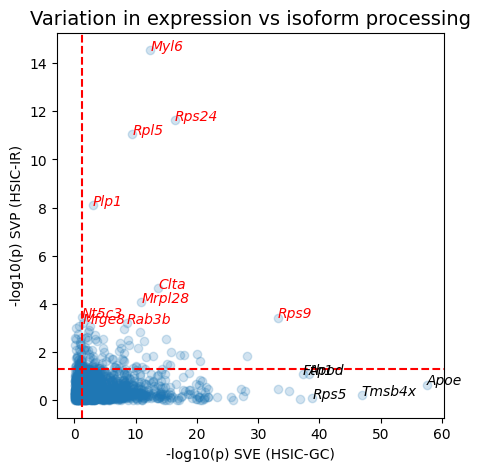
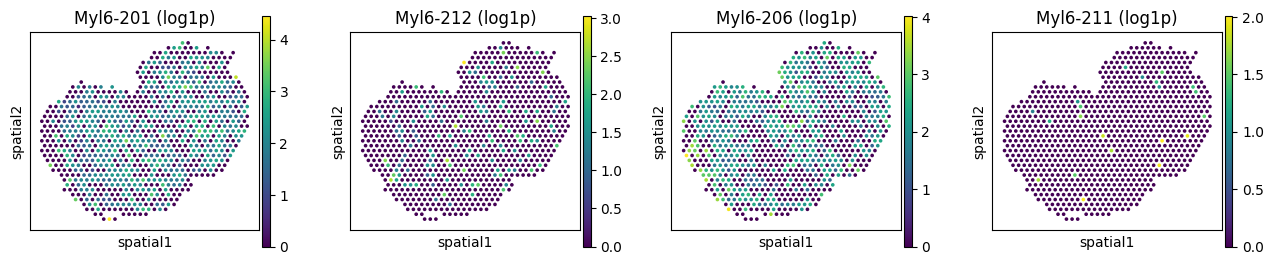
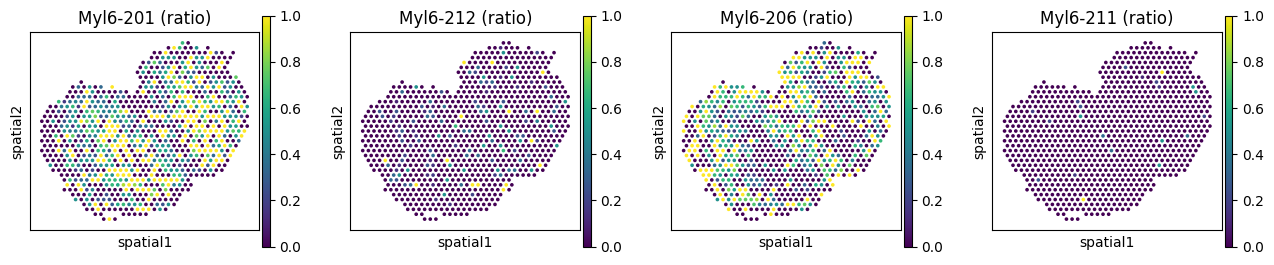
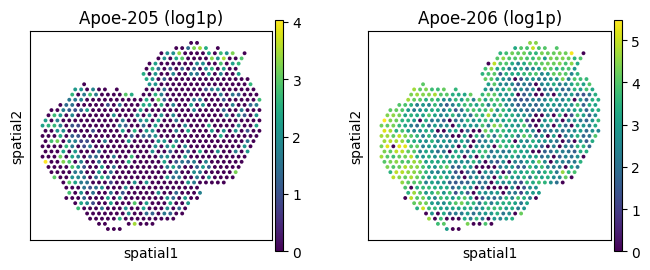
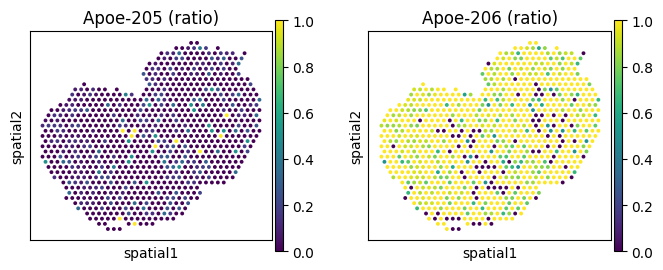
We can take a look at genes with spatially variable isoform usage as well as genes with only variable expression, to see how they differ.
# Compute isoform ratios and store in a new layer "ratios_obs"
add_ratio_layer(adata_ont, group_iso_by="gene_symbol", layer="counts", ratio_layer_key="ratios_obs")

# Spatially variably processed: Myl6
_gene = "Myl6"
_iso_to_plot = adata_ont.var.index[adata_ont.var['gene_symbol'] == _gene]
_name_to_plot = adata_ont.var.loc[adata_ont.var['gene_symbol'] == _gene, 'transcript_name']
_titles_log1p = [f"{name} (log1p)" for name in _name_to_plot]
_titles_ratio = [f"{name} (ratio)" for name in _name_to_plot]
with plt.rc_context({"figure.figsize": (3, 3)}):
    sc.pl.spatial(
        adata_ont, color=_iso_to_plot, title=_titles_log1p,
        img_key=None, layer='log1p', ncols = len(_iso_to_plot)
    )
    sc.pl.spatial(
        adata_ont, color=_iso_to_plot, title=_titles_ratio,
        img_key=None, layer='ratios_obs', ncols = len(_iso_to_plot)
    )
/var/folders/_f/m4v2g8c54gdfks59bp2f2cm80000gn/T/ipykernel_53470/3160921472.py:11: FutureWarning: Use `squidpy.pl.spatial_scatter` instead.
  sc.pl.spatial(
/var/folders/_f/m4v2g8c54gdfks59bp2f2cm80000gn/T/ipykernel_53470/3160921472.py:15: FutureWarning: Use `squidpy.pl.spatial_scatter` instead.
  sc.pl.spatial(
# Spatially variably expressed but not processed: Apoe
_gene = "Apoe"
_iso_to_plot = adata_ont.var.index[adata_ont.var['gene_symbol'] == _gene]
_name_to_plot = adata_ont.var.loc[adata_ont.var['gene_symbol'] == _gene, 'transcript_name']
_titles_log1p = [f"{name} (log1p)" for name in _name_to_plot]
_titles_ratio = [f"{name} (ratio)" for name in _name_to_plot]
with plt.rc_context({"figure.figsize": (3, 3)}):
    sc.pl.spatial(
        adata_ont, color=_iso_to_plot, title=_titles_log1p,
        img_key=None, layer='log1p', ncols = len(_iso_to_plot)
    )
    sc.pl.spatial(
        adata_ont, color=_iso_to_plot, title=_titles_ratio,
        img_key=None, layer='ratios_obs', ncols = len(_iso_to_plot)
    )
/var/folders/_f/m4v2g8c54gdfks59bp2f2cm80000gn/T/ipykernel_53470/1513142415.py:8: FutureWarning: Use `squidpy.pl.spatial_scatter` instead.
  sc.pl.spatial(
/var/folders/_f/m4v2g8c54gdfks59bp2f2cm80000gn/T/ipykernel_53470/1513142415.py:12: FutureWarning: Use `squidpy.pl.spatial_scatter` instead.
  sc.pl.spatial(
Differential isoform usage (DU) tests#
The covariates for DU tests can be any spot-level metadata, such as spatial regions or RBP expression levels.
Find isoform switching events between spatial regions#
We will first use the spatial region annotation available from the original SiT paper.
%%time
# Subset to the significant SVP genes
svp_gene_list = svp_res.query("pvalue < 0.01")["gene"].tolist()
adata_svp = adata_ont[:, adata_ont.var["gene_symbol"].isin(svp_gene_list)].copy()

# Create a model with design matrix based on spatial regions
model_region = SplisosmNP()
model_region.setup_data(
    adata=adata_svp,
    # will one-hot encode the region column in adata.obs
    design_mtx='region',
    spatial_key="spatial",
    layer="counts",
    group_iso_by="gene_symbol",
    gene_names="gene_symbol",
    min_counts=10,
    min_bin_pct=0.01,
    skip_spatial_kernel=True, # DU test does not require initializing spatial kernel
)
model_region
CPU times: user 19.1 ms, sys: 6.28 ms, total: 25.4 ms
Wall time: 33.6 ms
=== SplisosmNP
- Number of genes: 51
- Number of spots: 918
- Number of covariates: 5
- Average isoforms per gene: 2.6
=== Model configurations
- Spatial kernel source: identity (skip_spatial_kernel=True)
- k_neighbors: N/A, rho: 0.99
- Standardize spatial covariance: True
=== Test results
- Spatial variability: N/A
- Differential usage: N/A
%%time
# Conditional DU test using sklearn's GaussianProgressRegressor (default)
with warnings.catch_warnings():
    warnings.filterwarnings("ignore", category=ConvergenceWarning, message=".*is close to the specified.*")
    model_region.test_differential_usage(method="hsic-gp", gpr_backend="sklearn")

du_res = model_region.get_formatted_test_results(test_type="du").sort_values("pvalue")
du_res.head(5)
Covariates: 100%|██████████| 5/5 [00:01<00:00,  3.80it/s]
DU [hsic-gp]: 100%|██████████| 51/51 [00:00<00:00, 325.47it/s]
CPU times: user 1.38 s, sys: 841 ms, total: 2.22 s
Wall time: 1.52 s
| gene | covariate | statistic | pvalue | pvalue_adj | |
|---|---|---|---|---|---|
| 233 | Plp1 | region_Olfactory Nerve Layer (ONL) | 0.000973 | 0.000001 | 0.000038 |
| 130 | Nnat | region_Glomerular Layer (GL) | 0.003000 | 0.000001 | 0.000042 |
| 133 | Nnat | region_Olfactory Nerve Layer (ONL) | 0.001121 | 0.000002 | 0.000038 |
| 225 | Ap3s1 | region_Glomerular Layer (GL) | 0.002433 | 0.000002 | 0.000042 |
| 226 | Ap3s1 | region_Granule Cell Layer (GCL+RMS) | 0.000906 | 0.000002 | 0.000124 |
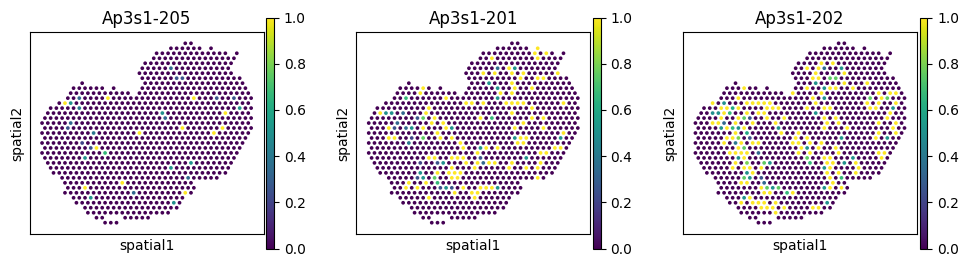
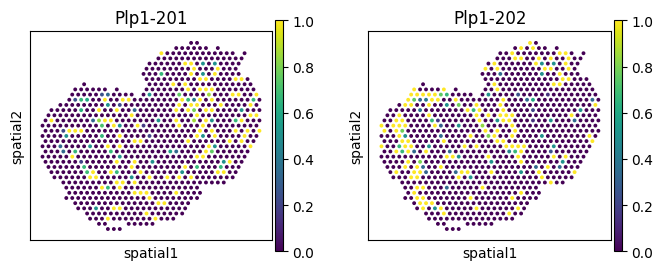
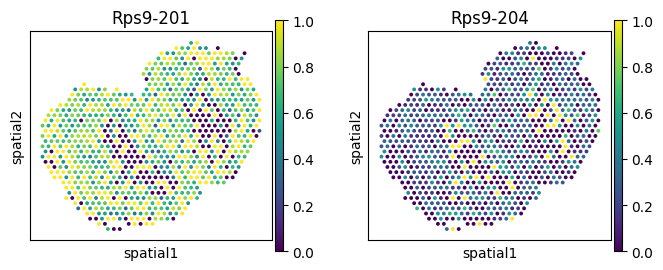
Let’s plot the most significant switching events for each region.
du_res.groupby("covariate").apply(
    lambda df: df.nsmallest(1, "pvalue"),
    include_groups=False
)
| gene | statistic | pvalue | pvalue_adj | ||
|---|---|---|---|---|---|
| covariate | |||||
| region_Glomerular Layer (GL) | 130 | Nnat | 0.003000 | 0.000001 | 0.000042 |
| region_Granule Cell Layer (GCL+RMS) | 226 | Ap3s1 | 0.000906 | 0.000002 | 0.000124 |
| region_Mitral Cell Layer (MCL) | 227 | Ap3s1 | 0.002586 | 0.000025 | 0.001298 |
| region_Olfactory Nerve Layer (ONL) | 233 | Plp1 | 0.000973 | 0.000001 | 0.000038 |
| region_Outer plexiform Layer (EPL) | 94 | Rps9 | 0.000807 | 0.009689 | 0.390307 |
for _gene in ['Nnat', 'Ap3s1', 'Plp1', 'Rps9']:
    _iso_to_plot = adata_ont.var.index[adata_ont.var['gene_symbol'] == _gene]
    _name_to_plot = adata_ont.var.loc[adata_ont.var['gene_symbol'] == _gene, 'transcript_name']
    with plt.rc_context({"figure.figsize": (3, 3)}):
        sc.pl.spatial(
            adata_ont, color=_iso_to_plot, title=_name_to_plot,
            img_key=None, layer='ratios_obs', ncols = len(_iso_to_plot)
        )
/var/folders/_f/m4v2g8c54gdfks59bp2f2cm80000gn/T/ipykernel_53470/720942732.py:5: FutureWarning: Use `squidpy.pl.spatial_scatter` instead.
  sc.pl.spatial(

/var/folders/_f/m4v2g8c54gdfks59bp2f2cm80000gn/T/ipykernel_53470/720942732.py:5: FutureWarning: Use `squidpy.pl.spatial_scatter` instead.
  sc.pl.spatial(
/var/folders/_f/m4v2g8c54gdfks59bp2f2cm80000gn/T/ipykernel_53470/720942732.py:5: FutureWarning: Use `squidpy.pl.spatial_scatter` instead.
  sc.pl.spatial(
/var/folders/_f/m4v2g8c54gdfks59bp2f2cm80000gn/T/ipykernel_53470/720942732.py:5: FutureWarning: Use `squidpy.pl.spatial_scatter` instead.
  sc.pl.spatial(
Find potential RBP regulators of isoform switching events#
Next, we load the short-read-based expression matrix of all RNA binding proteins (RBPs) in the same dataset. The list of RBPs is obtained from EuRBPDB, excluding ribosomal proteins and non-canonical RBPs.
adata_rbp = sc.read(rbp_path)
adata_rbp

# # log normalize is performed with all genes
# sc.pp.normalize_total(adata_sr, target_sum=1e4)
# sc.pp.log1p(adata_sr)
# adata_sr.layers['log1p'] = adata_sr.X.copy()
# data_rbp = adata_sr[:, adata_sr.var_names.isin(rbp_genes)].copy()
AnnData object with n_obs × n_vars = 918 × 1399
    obs: 'orig.ident', 'nCount_RNA', 'nFeature_RNA', 'region', 'AtoI_total', 'AtoI_ratio', 'AtoI_detected', 'in_tissue', 'array_row', 'array_col'
    var: 'features', 'n_cells', 'is_rbp', 'pvalue_adj_hsic', 'pvalue_adj_sparkx', 'is_visium_sve'
    uns: 'log1p', 'spatial'
    obsm: 'spatial'
    layers: 'counts', 'log1p'
Let’s first run SVE test (HSIC-GC) to find spatially variably expressed RBPs.
%%time
# Run the HSIC-GC wrapper function (anndata mode)
sve_rbp = run_hsic_gc(
    adata=adata_rbp,
    layer='counts',
    spatial_key='spatial',
    null_method='eig',
    k_neighbors=4,
    rho=0.99,
    standardize_cov=True,
)
sve_rbp = pd.DataFrame(
    {'gene': adata_rbp.var_names} | sve_rbp
).sort_values("pvalue")

print(f"Number of SVE RBPs (FDR < 0.01): {(sve_rbp['pvalue_adj'] < 0.01).sum()} / {adata_rbp.shape[1]}")
sve_rbp.head(5)
Genes: 100%|██████████| 1399/1399 [00:02<00:00, 513.00it/s]
Number of SVE RBPs (FDR < 0.01): 458 / 1399
CPU times: user 2.82 s, sys: 33.1 ms, total: 2.85 s
Wall time: 2.82 s
| gene | statistic | pvalue | method | null_method | n_spots | pvalue_adj | |
|---|---|---|---|---|---|---|---|
| 1326 | Ndufa2 | 0.244349 | 1.110234e-29 | hsic-gc | eig | 918 | 1.553217e-26 |
| 1185 | Arf3 | 0.018160 | 1.046814e-27 | hsic-gc | eig | 918 | 7.322465e-25 |
| 876 | Eef1a1 | 0.392478 | 2.532602e-27 | hsic-gc | eig | 918 | 1.181037e-24 |
| 911 | Ewsr1 | 0.033771 | 7.182231e-25 | hsic-gc | eig | 918 | 2.511985e-22 |
| 300 | Rab2a | 0.058817 | 4.077941e-23 | hsic-gc | eig | 918 | 1.141008e-20 |
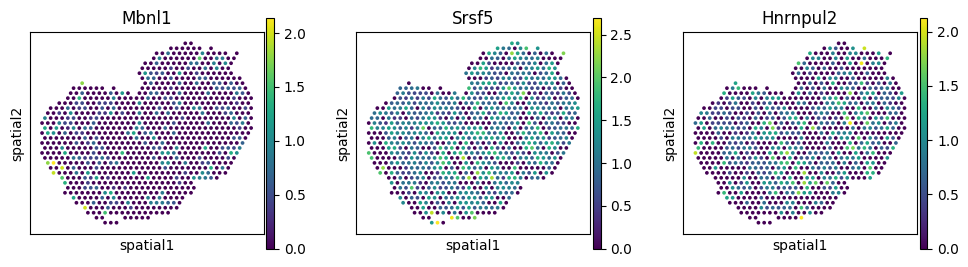
We can then run conditional HSIC (method="hsic-gp") to find potential RBP regulators of the isoform switching events.
%%time
# Subset to the significant SVP genes
svp_gene_list = svp_res.query("pvalue < 0.01")["gene"].tolist()
adata_svp = adata_ont[:, adata_ont.var["gene_symbol"].isin(svp_gene_list)].copy()

# Subset to the significant SVE RBPs
sve_rbp_list = sve_rbp.query("pvalue_adj < 0.01")["gene"].tolist()
adata_rbp_sve = adata_rbp[
    adata_svp.obs_names,
    adata_rbp.var_names.isin(sve_rbp_list)
]
design_mtx = adata_rbp_sve.layers['log1p'].copy()
covariate_names = adata_rbp_sve.var_names.tolist()

# Create a model with RBP expression as covariates
model_rbp = SplisosmNP()
model_rbp.setup_data(
    adata=adata_svp,
    design_mtx=design_mtx,
    covariate_names=covariate_names,
    spatial_key="spatial",
    layer="counts",
    group_iso_by="gene_symbol",
    gene_names="gene_symbol",
    min_counts=10,
    min_bin_pct=0.01,
    skip_spatial_kernel=True, # DU test does not require initializing spatial kernel
)
model_rbp
CPU times: user 24.7 ms, sys: 6.32 ms, total: 31 ms
Wall time: 35.1 ms
=== SplisosmNP
- Number of genes: 51
- Number of spots: 918
- Number of covariates: 458
- Average isoforms per gene: 2.6
=== Model configurations
- Spatial kernel source: identity (skip_spatial_kernel=True)
- k_neighbors: N/A, rho: 0.99
- Standardize spatial covariance: True
=== Test results
- Spatial variability: N/A
- Differential usage: N/A
%%time
# Conditional: spatially residualize both probe usage and RBP expression
with warnings.catch_warnings():
    warnings.filterwarnings("ignore", category=ConvergenceWarning, message=".*is close to the specified.*")
    model_rbp.test_differential_usage(method="hsic-gp")
    du_rbp_res = model_rbp.get_formatted_test_results(test_type="du").rename(columns={"pvalue": "pvalue_np"})
Covariates: 100%|██████████| 458/458 [02:05<00:00,  3.64it/s]
DU [hsic-gp]: 100%|██████████| 51/51 [00:12<00:00,  3.95it/s]
CPU times: user 2min 12s, sys: 1min 10s, total: 3min 23s
Wall time: 2min 22s
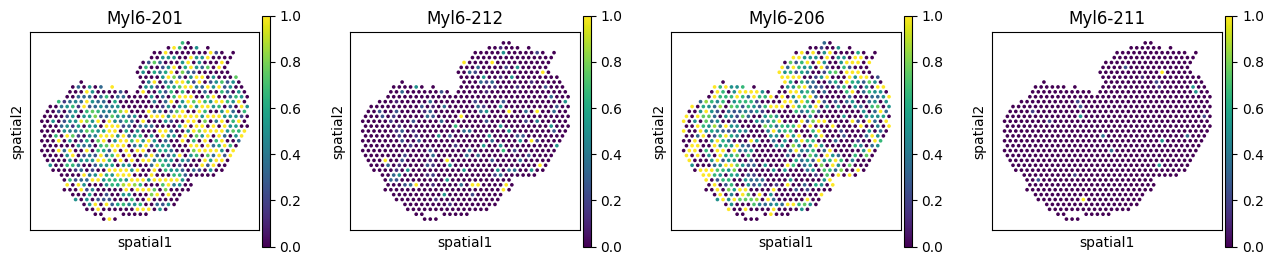
du_rbp_res.query("gene == 'Myl6'").sort_values("pvalue_np").head(5)
| gene | covariate | statistic | pvalue_np | pvalue_adj | |
|---|---|---|---|---|---|
| 14059 | Myl6 | Zfp385c | 0.003972 | 0.000032 | 0.001618 |
| 13900 | Myl6 | Lsm5 | 0.003395 | 0.000127 | 0.006488 |
| 13815 | Myl6 | Mbnl1 | 0.003372 | 0.000130 | 0.006628 |
| 14092 | Myl6 | Srsf5 | 0.003094 | 0.000270 | 0.013778 |
| 14190 | Myl6 | Hnrnpul2 | 0.002612 | 0.000678 | 0.030727 |
_rbps = ['Mbnl1', 'Srsf5', 'Hnrnpul2']
_gene = 'Myl6'
with plt.rc_context({"figure.figsize": (3, 3)}):
    sc.pl.spatial(
        adata_rbp, color=_rbps, title=_rbps,
        img_key=None, layer='log1p', ncols = len(_rbps)
    )

_iso_to_plot = adata_ont.var.index[adata_ont.var['gene_symbol'] == _gene]
_name_to_plot = adata_ont.var.loc[adata_ont.var['gene_symbol'] == _gene, 'transcript_name']
with plt.rc_context({"figure.figsize": (3, 3)}):
    sc.pl.spatial(
        adata_ont, color=_iso_to_plot, title=_name_to_plot,
        img_key=None, layer='ratios_obs', ncols = len(_iso_to_plot)
    )
/var/folders/_f/m4v2g8c54gdfks59bp2f2cm80000gn/T/ipykernel_53470/1108538305.py:4: FutureWarning: Use `squidpy.pl.spatial_scatter` instead.
  sc.pl.spatial(
/var/folders/_f/m4v2g8c54gdfks59bp2f2cm80000gn/T/ipykernel_53470/1108538305.py:12: FutureWarning: Use `squidpy.pl.spatial_scatter` instead.
  sc.pl.spatial(
(Optional) Differential usage tests with SplisosmGLMM#
Conventionally, differential splicing analysis is often performed using parametric models such as generalized linear models (GLM), which are implemented in SplisosmGLMM. We can run the same DU tests using SplisosmGLMM and compare the results with the non-parametric HSIC-based tests (results will be different).
GLM-based differential usage test (analogous to SplisosmNP with the unconditional method='hsic')#
Let’s first run the unconditional SplisosmNP HSIC test as baseline.
%%time
# Model setup
model_hsic = SplisosmNP()
model_hsic.setup_data(
    adata=adata_svp,
    design_mtx=design_mtx,
    covariate_names=covariate_names,
    spatial_key="spatial",
    layer="counts",
    group_iso_by="gene_symbol",
    gene_names="gene_symbol",
    min_counts=10,
    min_bin_pct=0.01,
    skip_spatial_kernel=True, # DU test does not require initializing spatial kernel
)

# Unconditional HSIC test
model_hsic.test_differential_usage(method="hsic")
du_hsic_res = model_hsic.get_formatted_test_results(
    test_type="du"
).rename(columns={"pvalue": "pvalue_hsic"})
DU [hsic]: 100%|██████████| 51/51 [00:13<00:00, 3.91it/s]
CPU times: user 10.6 s, sys: 34.6 s, total: 45.2 s
Wall time: 16.6 s
Next, set up a Multinomial GLM model and run the score test for association.
%%time
# Model setup for GLM-based DU test
model_glm = SplisosmGLMM(
    model_type="glm", # the unconditional DU test
)
model_glm.setup_data(
    adata=adata_svp,
    design_mtx=design_mtx,
    covariate_names=covariate_names,
    spatial_key="spatial",
    layer="counts",
    group_iso_by="gene_symbol",
    gene_names="gene_symbol",
    min_counts=10,
    min_bin_pct=0.01,
)

# Model fitting
model_glm.fit(with_design_mtx=False)

# DU test with the score statistic
model_glm.test_differential_usage(method="score")
du_glm = model_glm.get_formatted_test_results(test_type="du").sort_values("pvalue")
du_glm.rename(columns={"pvalue": "pvalue_glm"}, inplace=True)
Fitting with single core for 51 genes (batch_size=1).
Fitting: 100%|██████████| 51/51 [00:00<00:00, 353.68it/s]
Fitting finished. Time elapsed: 0.15 seconds.
DU [score]: 100%|██████████| 51/51 [00:00<00:00, 63.45it/s]
CPU times: user 977 ms, sys: 114 ms, total: 1.09 s
Wall time: 977 ms
GLMM-based differential usage test (analogous to SplisosmNP with the conditional method='hsic-gp')#
%%time
# Model setup for GLMM-based DU test
model_glmm = SplisosmGLMM(
    model_type="glmm-full",
    fitting_method="joint_gd",
    var_fix_sigma=True,
    fitting_configs={"max_epochs": -1}, # until convergence
    device="cpu", # optional GPU support
    approx_rank=None # optional low-rank kernel approximation
)
model_glmm.setup_data(
    adata=adata_svp,
    design_mtx=design_mtx,
    covariate_names=covariate_names,
    spatial_key="spatial",
    layer="counts",
    group_iso_by="gene_symbol",
    gene_names="gene_symbol",
    min_counts=10,
    min_bin_pct=0.01,
    group_gene_by_n_iso=False, # optional batching
)

# Model fitting
model_glmm.fit(
    n_jobs=1, # optional joblib parallelization
    batch_size=1, # optional batching
    with_design_mtx=False,
    quiet=True, # suppress non-convergence warnings
)

# DU test with the score statistic
model_glmm.test_differential_usage(method="score")
du_glmm = model_glmm.get_formatted_test_results(test_type="du").sort_values("pvalue")
du_glmm.rename(columns={"pvalue": "pvalue_glmm"}, inplace=True)
Fitting with single core for 51 genes (batch_size=1).
Fitting: 100%|██████████| 51/51 [02:41<00:00, 3.16s/it]
Fitting finished. Time elapsed: 161.24 seconds.
DU [score]: 100%|██████████| 51/51 [00:00<00:00, 67.07it/s]
CPU times: user 2min 44s, sys: 18.5 s, total: 3min 3s
Wall time: 2min 42s
Let’s check model fitting summary and see how long it takes for the per-gene GLMMs to converge.
model_glmm.get_training_summary().head(5)
| model_type | converged | best_loss | best_epoch | fitting_time_s | |
|---|---|---|---|---|---|
| gene | |||||
| Ift20 | glmm-full | True | 597.396851 | 6820 | 4.659643 |
| Zmat2 | glmm-full | True | -96.564835 | 5447 | 3.237719 |
| Nt5c3 | glmm-full | True | -221.691910 | 4606 | 2.735967 |
| Btbd6 | glmm-full | True | -4024.287354 | 2722 | 2.065089 |
| Comt | glmm-full | True | -342.045227 | 4685 | 2.728078 |
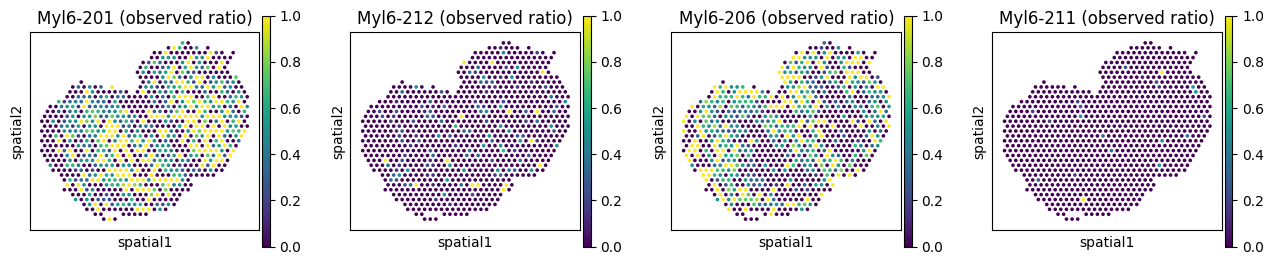
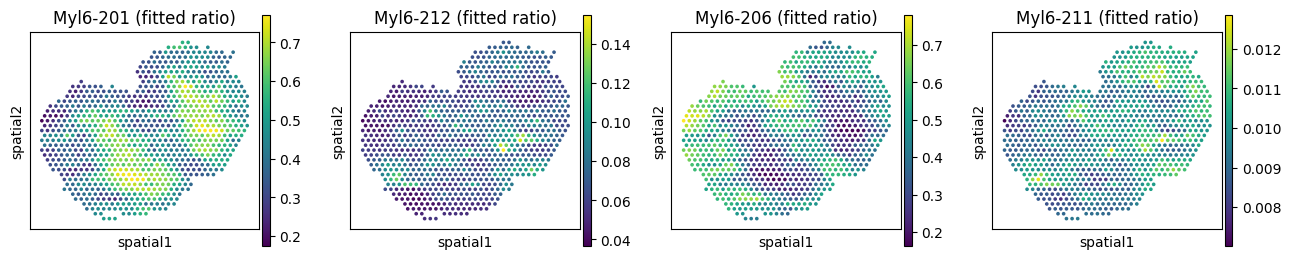
We can visualize the inferred posterior isoform ratios from the GLMM model. Due to data sparsity, the model almost always underestimates the random effect variance (sigma^2), and the resulting ratios look over-smoothed. Setting var_fix_sigma=True (our default) helps mitigate this issue.
# Extract anndata with fitted ratios for visualization
adata_fit = model_glmm.get_fitted_ratios_anndata(layer_name="ratios_glmm")

# Observed vs fitted ratios for Myl6
_iso_to_plot = adata_fit.var.index[adata_fit.var['gene_symbol'] == _gene]
_name_to_plot = adata_fit.var.loc[adata_fit.var['gene_symbol'] == _gene, 'transcript_name']
_titles_obs = [f"{name} (observed ratio)" for name in _name_to_plot]
_titles_glmm = [f"{name} (fitted ratio)" for name in _name_to_plot]
with plt.rc_context({"figure.figsize": (3, 3)}):
    sc.pl.spatial(
        adata_fit, color=_iso_to_plot, title=_titles_obs,
        img_key=None, layer='ratios_obs', ncols = len(_iso_to_plot)
    )
    sc.pl.spatial(
        adata_fit, color=_iso_to_plot, title=_titles_glmm,
        img_key=None, layer='ratios_glmm', ncols = len(_iso_to_plot)
    )
/var/folders/_f/m4v2g8c54gdfks59bp2f2cm80000gn/T/ipykernel_53470/3009630499.py:10: FutureWarning: Use `squidpy.pl.spatial_scatter` instead.
  sc.pl.spatial(
/var/folders/_f/m4v2g8c54gdfks59bp2f2cm80000gn/T/ipykernel_53470/3009630499.py:14: FutureWarning: Use `squidpy.pl.spatial_scatter` instead.
  sc.pl.spatial(
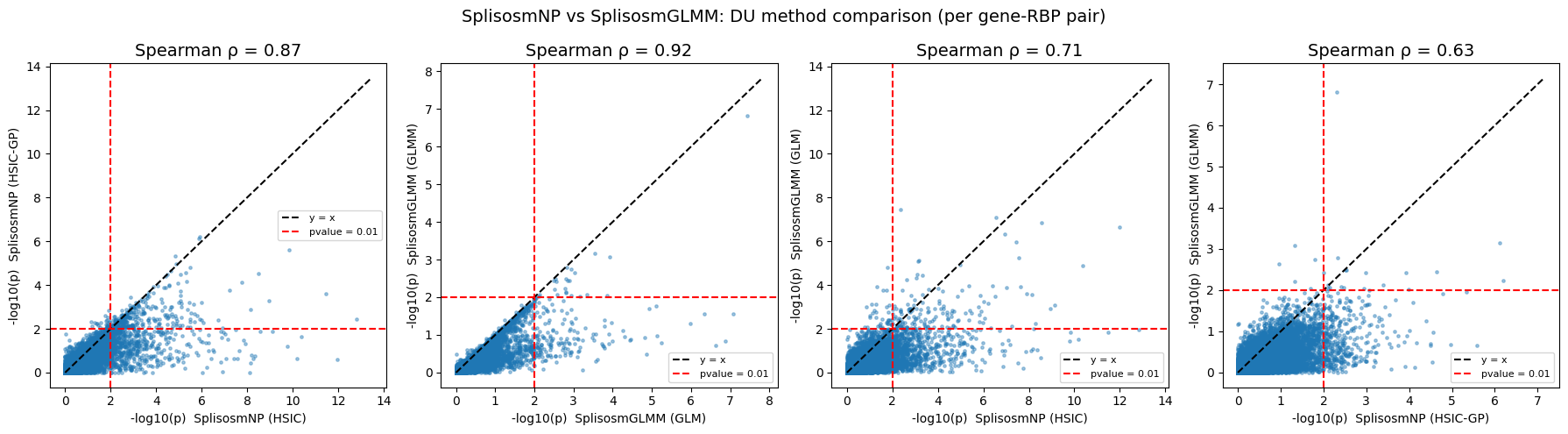
Compare GLM/GLMM results with HSIC-based results#
def _neg_log10(p, floor=1e-300):
    return -np.log10(np.clip(p, floor, 1.0))

merge_cols = ["gene", "covariate"]

du_all = (
    du_rbp_res[merge_cols + ["pvalue_np"]]
    .merge(du_hsic_res[merge_cols + ["pvalue_hsic"]], on=merge_cols, how="inner")
    .merge(du_glm[merge_cols + ["pvalue_glm"]], on=merge_cols, how="inner")
    .merge(du_glmm[merge_cols + ["pvalue_glmm"]], on=merge_cols, how="inner")
)

# Spearman correlations between DU methods
rho_hsic, _ = spearmanr(du_all["pvalue_hsic"],    du_all["pvalue_np"])
rho_glmm, _  = spearmanr(du_all["pvalue_glm"],    du_all["pvalue_glmm"])
rho_np_glm, _  = spearmanr(du_all["pvalue_hsic"],    du_all["pvalue_glm"])
rho_np_glmm, _  = spearmanr(du_all["pvalue_np"],    du_all["pvalue_glmm"])

print(f"Spearman ρ(HSIC vs HSIC-GP) = {rho_hsic:.3f}")
print(f"Spearman ρ(GLM vs GLMM) = {rho_glmm:.3f}")
print(f"Spearman ρ(HSIC vs GLM) = {rho_np_glm:.3f}")
print(f"Spearman ρ(HSIC-GP vs GLMM) = {rho_np_glmm:.3f}")
Spearman ρ(HSIC vs HSIC-GP) = 0.869
Spearman ρ(GLM vs GLMM) = 0.922
Spearman ρ(HSIC vs GLM) = 0.708
Spearman ρ(HSIC-GP vs GLMM) = 0.627
pairs_du = [
    ("pvalue_hsic",   "pvalue_np",
     "SplisosmNP (HSIC)", "SplisosmNP (HSIC-GP)",  rho_hsic),
    ("pvalue_glm",   "pvalue_glmm",
     "SplisosmGLMM (GLM)", "SplisosmGLMM (GLMM)",  rho_glmm),
    ("pvalue_hsic",    "pvalue_glm",
     "SplisosmNP (HSIC)", "SplisosmGLMM (GLM)",  rho_np_glm),
    ("pvalue_np",    "pvalue_glmm",
     "SplisosmNP (HSIC-GP)", "SplisosmGLMM (GLMM)",  rho_np_glmm),
]

fig, axes = plt.subplots(1, 4, figsize=(18, 5))
for ax, (cx, cy, lx, ly, rho) in zip(axes, pairs_du):
    x = _neg_log10(du_all[cx].astype(float).values, floor=1e-100)
    y = _neg_log10(du_all[cy].astype(float).values, floor=1e-100)
    ax.scatter(x, y, s=6, alpha=0.4, rasterized=True)
    lim = max(x.max(), y.max()) * 1.05
    ax.plot([0, lim], [0, lim], "k--", label="y = x")
    ax.axhline(_neg_log10(0.01), color="red", linestyle="--", label="pvalue = 0.01")
    ax.axvline(_neg_log10(0.01), color="red", linestyle="--")
    ax.set_xlabel(f"-log10(p)  {lx}", fontsize=10)
    ax.set_ylabel(f"-log10(p)  {ly}", fontsize=10)
    ax.set_title(f"Spearman ρ = {rho:.2f}", fontsize=14)
    ax.legend(fontsize=8)

fig.suptitle("SplisosmNP vs SplisosmGLMM: DU method comparison (per gene-RBP pair)", fontsize=14)
fig.tight_layout()
plt.show()
For reproducibility#
import sys
from datetime import date
import splisosm

print("Last updated:", date.today())
print("Python:", sys.version.split()[0])
print("splisosm:", getattr(splisosm, "__version__", "unknown"))
Last updated: 2026-04-08
Python: 3.12.13
splisosm: 1.1.0